Conjunctions: Pengertian, Jenis, Fungsi, Cara Penggunaan, dan Contoh dalam Bahasa Inggris
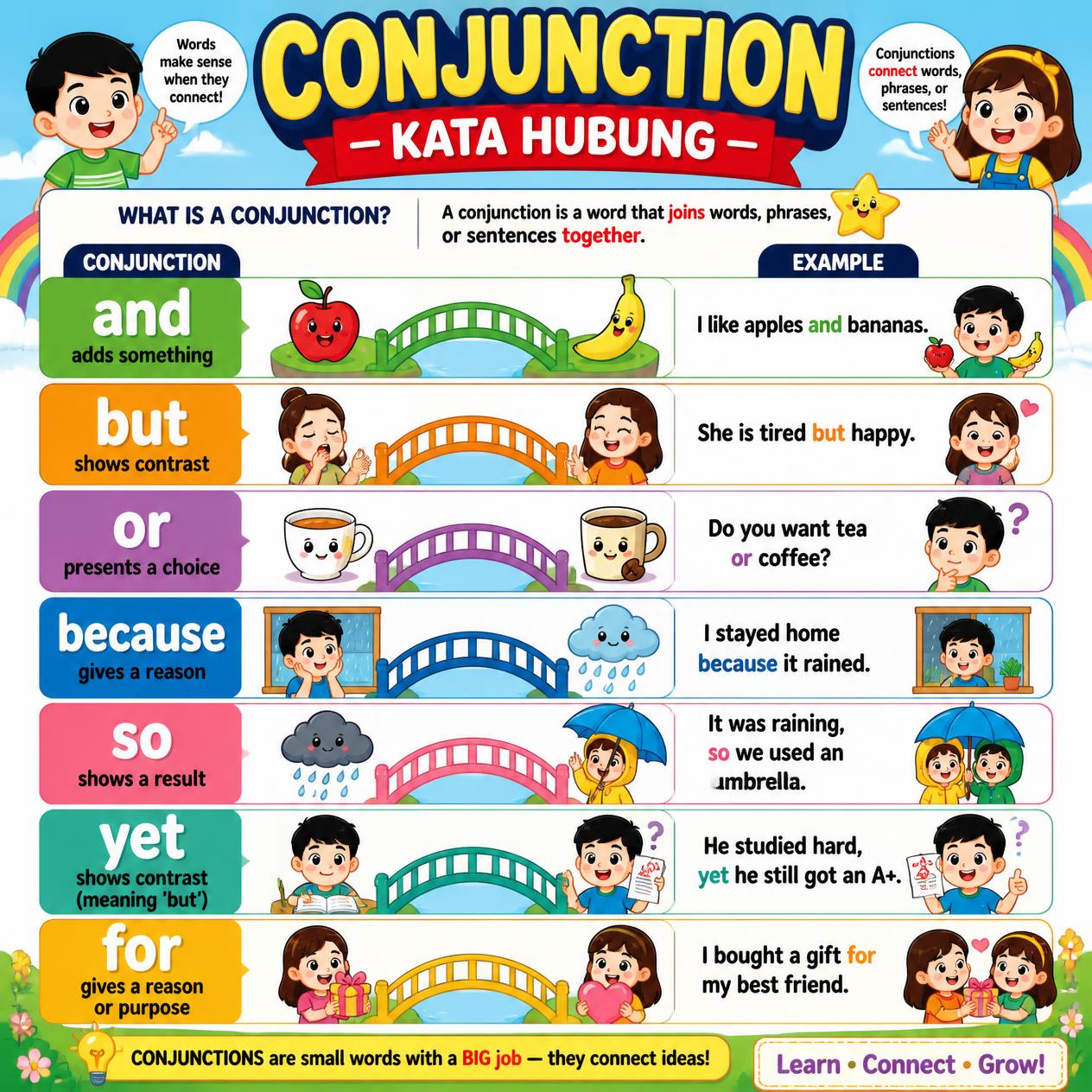
Because + Subject + Verb
We stayed home because it was raining.
Kami tinggal di rumah karena sedang hujan.
Because of + Noun/Noun Phrase
We stayed home because of the rain.
Kami tinggal di rumah karena hujan.
Perhatikan:
❌ because of it was raining
✅ because it was raining
❌ because the rain
✅ because of the rain
P. DESPITE = meskipun
Despite biasanya diikuti noun/noun phrase atau gerund (-ing).
Despite the rain, we played football.
Artinya:
Meskipun hujan, kami bermain sepak bola.
Despite being tired, she continued working.
Artinya:
Meskipun lelah, dia tetap bekerja.
Q. IN SPITE OF = meskipun
Fungsinya hampir sama dengan despite.
In spite of the rain, they went outside.
Artinya:
Meskipun hujan, mereka pergi keluar.
Perbandingan:
Although + Subject + Verb
Although it was raining, we played football.
Despite/In spite of + Noun
Despite the rain, we played football.
3. CORRELATIVE CONJUNCTION
Correlative conjunction digunakan berpasangan.
Beberapa pasangan penting:
| Correlative Conjunction | Arti |
|---|---|
| both … and | baik … maupun … |
| either … or | salah satu … atau … |
| neither … nor | tidak … maupun … |
| not only … but also | tidak hanya … tetapi juga |
| whether … or | apakah … atau … |
A. BOTH … AND
Berarti baik … maupun ….
Both Rina and Sinta are students.
Artinya:
Rina dan Sinta sama-sama siswa.
She likes both English and Mathematics.
Artinya:
Dia menyukai Bahasa Inggris dan Matematika.
B. EITHER … OR
Berarti salah satu … atau …
You can choose either tea or coffee.
Artinya:
Kamu dapat memilih teh atau kopi.
Either Rina or Sinta will help me.
Artinya:
Rina atau Sinta yang akan membantu saya.
C. NEITHER … NOR
Berarti tidak … dan juga tidak …
Neither Rina nor Sinta is absent.
Artinya:
Baik Rina maupun Sinta tidak ada yang tidak hadir.
Lebih natural dalam bahasa Indonesia:
Rina dan Sinta sama-sama hadir.
Contoh:
I like neither coffee nor tea.
Artinya:
Saya tidak menyukai kopi maupun teh.
D. NOT ONLY … BUT ALSO
Berarti tidak hanya … tetapi juga …
She is not only smart but also hardworking.
Artinya:
Dia tidak hanya pintar tetapi juga rajin.
He can not only sing but also dance.
Artinya:
Dia tidak hanya bisa menyanyi tetapi juga menari.
E. WHETHER … OR
Berarti apakah … atau …
I don’t know whether he will come or not.
Artinya:
Saya tidak tahu apakah dia akan datang atau tidak.
C. RINGKASAN CONJUNCTION BERDASARKAN FUNGSI
| Fungsi | Conjunction | Arti |
|---|---|---|
| Menambahkan | and | dan |
| Pertentangan | but | tetapi |
| Pilihan | or | atau |
| Akibat | so | jadi/sehingga |
| Alasan | because | karena |
| Pertentangan | although | meskipun |
| Pertentangan | though | meskipun |
| Pertentangan kuat | even though | meskipun |
| Syarat | if | jika |
| Syarat negatif | unless | kecuali jika |
| Waktu | when | ketika |
| Waktu bersamaan | while | sementara/ketika |
| Waktu | before | sebelum |
| Waktu | after | setelah |
| Waktu | since | sejak |
| Waktu | until | sampai |
| Alasan | as | karena |
| Tujuan | so that | agar |
| Alasan + noun | because of | karena |
| Pertentangan + noun | despite | meskipun |
| Pertentangan + noun | in spite of | meskipun |
D. PERBEDAAN CONJUNCTION YANG SERING MEMBINGUNGKAN
1. BECAUSE vs SO
Because = alasan
I stayed home because I was sick.
Saya tinggal di rumah karena saya sakit.
So = akibat
I was sick, so I stayed home.
Saya sakit, jadi saya tinggal di rumah.
Pola mudah:
CAUSE + SO + RESULT
It rained, so I stayed home.
RESULT + BECAUSE + CAUSE
I stayed home because it rained.
2. BUT vs ALTHOUGH
Keduanya menunjukkan pertentangan.
But:
It was raining, but we went outside.
Although:
Although it was raining, we went outside.
Artinya sama:
Meskipun hujan, kami pergi keluar.
Catatan penting: jangan menggunakan although + but dalam satu struktur yang sama.
❌ Although it was raining, but we went outside.
✅ Although it was raining, we went outside.
3. BECAUSE vs BECAUSE OF
Because + clause
I stayed home because I was sick.
Because of + noun
I stayed home because of my illness.
4. ALTHOUGH vs DESPITE
Although + Subject + Verb
Although it was raining, we played football.
Despite + noun/gerund
Despite the rain, we played football.
E. PUNCTUATION / TANDA BACA
Ketika dependent clause berada di awal kalimat, biasanya digunakan koma.
Because I was sick, I stayed home.
Although it was raining, we went outside.
When I arrived, they were eating.
Tetapi jika dependent clause berada setelah main clause, biasanya tidak perlu koma.
I stayed home because I was sick.
We went outside although it was raining.
F. CONTOH DALAM KEHIDUPAN SEHARI-HARI
1. At school
I study English because I want to improve my skills.
Saya belajar Bahasa Inggris karena ingin meningkatkan kemampuan saya.
2. At home
I was hungry, so I ate breakfast.
Saya lapar, jadi saya sarapan.
3. With friends
We can play football or basketball.
Kita bisa bermain sepak bola atau basket.
4. About weather
Although it was raining, we went to school.
Meskipun hujan, kami pergi ke sekolah.
5. About study
I will study hard so that I can pass the exam.
Saya akan belajar dengan giat agar saya dapat lulus ujian.
G. LATIHAN SOAL
A. Choose the correct conjunction!
1. I like English ___ Mathematics.
A. but
B. and
C. because
D. although
2. She was tired, ___ she continued studying.
A. but
B. because
C. so
D. or
3. I stayed at home ___ it was raining.
A. and
B. but
C. because
D. or
4. It was raining, ___ we stayed at home.
A. so
B. but
C. because
D. although
5. Would you like tea ___ coffee?
A. and
B. but
C. or
D. because
6. ___ he was tired, he continued working.
A. Because
B. Although
C. So
D. And
7. I will call you ___ I arrive.
A. when
B. but
C. because
D. or
8. Wash your hands ___ you eat.
A. after
B. before
C. because
D. so
9. She was cooking ___ her brother was watching TV.
A. while
B. because
C. or
D. but
10. Study hard ___ you will pass the exam.
A. because
B. and
C. so
D. or
H. KUNCI JAWABAN
| No. | Jawaban |
|---|---|
| 1 | B. and |
| 2 | A. but |
| 3 | C. because |
| 4 | A. so |
| 5 | C. or |
| 6 | B. Although |
| 7 | A. when |
| 8 | B. before |
| 9 | A. while |
| 10 | D. or |
I. PEMBAHASAN LENGKAP
1. I like English ___ Mathematics.
Jawaban: B. and
I like English and Mathematics.
And digunakan untuk menambahkan dua hal.
Artinya:
Saya menyukai Bahasa Inggris dan Matematika.
2. She was tired, ___ she continued studying.
Jawaban: A. but
She was tired, but she continued studying.
Ada pertentangan antara lelah dan tetap belajar.
Artinya:
Dia lelah, tetapi dia tetap belajar.
3. I stayed at home ___ it was raining.
Jawaban: C. because
I stayed at home because it was raining.
Because memberikan alasan.
Artinya:
Saya tinggal di rumah karena sedang hujan.
4. It was raining, ___ we stayed at home.
Jawaban: A. so
It was raining, so we stayed at home.
Hujan adalah sebab dan tinggal di rumah adalah akibat.
Artinya:
Hujan turun, jadi kami tinggal di rumah.
5. Would you like tea ___ coffee?
Jawaban: C. or
Would you like tea or coffee?
Ada dua pilihan: tea atau coffee.
Artinya:
Apakah kamu mau teh atau kopi?
6. ___ he was tired, he continued working.
Jawaban: B. Although
Although he was tired, he continued working.
Ada pertentangan antara tired dan continued working.
Artinya:
Meskipun dia lelah, dia tetap bekerja.
7. I will call you ___ I arrive.
Jawaban: A. when
I will call you when I arrive.
When menunjukkan waktu.
Artinya:
Saya akan meneleponmu ketika saya tiba.
8. Wash your hands ___ you eat.
Jawaban: B. before
Wash your hands before you eat.
Before berarti sebelum.
Artinya:
Cucilah tanganmu sebelum makan.
9. She was cooking ___ her brother was watching TV.
Jawaban: A. while
She was cooking while her brother was watching TV.
Dua aktivitas berlangsung bersamaan.
Artinya:
Dia sedang memasak sementara saudara laki-lakinya sedang menonton TV.
10. Study hard ___ you will pass the exam.
Jawaban: D. or
Study hard or you will fail the exam.
Catatan: jika pilihan yang tersedia adalah or, kalimat yang paling tepat secara makna adalah:
Study hard, or you will fail the exam.
Artinya:
Belajarlah dengan giat, atau kamu akan gagal dalam ujian.
Jadi, soal nomor 10 sebaiknya ditulis seperti itu agar strukturnya jelas.
J. LATIHAN LANJUTAN
Gabungkan dua kalimat berikut menggunakan conjunction yang tepat.
1.
I was hungry.
I ate some rice.
→ I was hungry, so I ate some rice.
Artinya:
Saya lapar, jadi saya makan nasi.
2.
Rina is smart.
Rina is hardworking.
→ Rina is smart and hardworking.
Artinya:
Rina pintar dan rajin.
3.
He was sick.
He went to school.
→ He was sick, but he went to school.
Artinya:
Dia sakit, tetapi dia pergi ke sekolah.
4.
I didn’t go outside.
It was raining.
→ I didn’t go outside because it was raining.
Artinya:
Saya tidak pergi keluar karena sedang hujan.
5.
She was tired.
She finished her homework.
→ Although she was tired, she finished her homework.
Artinya:
Meskipun dia lelah, dia menyelesaikan pekerjaan rumahnya.
K. CARA MUDAH MENGINGAT CONJUNCTION
Gunakan tabel berikut sebagai ringkasan cepat:
AND → menambah
BUT → berlawanan
OR → memilih
SO → akibat
BECAUSE → alasan
ALTHOUGH → pertentangan
IF → syarat
WHEN → waktu
WHILE → bersamaan
BEFORE → sebelum
AFTER → setelah
UNTIL → sampai
UNLESS → jika tidak
SO THAT → tujuan
DESPITE → meskipun + noun
BECAUSE OF → karena + noun
Rumus paling penting:
AND
A + and + B
BUT
A + but + B
OR
A + or + B
SO
Cause + so + Result
BECAUSE
Result + because + Cause
ALTHOUGH
Although + Clause, + Main Clause
IF
If + condition, + result
WHEN
When + time clause, + main clause
DESPITE
Despite + noun/gerund, + main clause
BECAUSE OF
Because of + noun, + main clause
Dengan memahami pola tersebut, siswa akan lebih mudah menentukan conjunction yang tepat berdasarkan hubungan makna antara dua bagian kalimat.

Post Comment