Direct & Indirect Speech: Pengertian, Fungsi, Jenis, Rumus, Contoh, dan Cara Menggunakannya
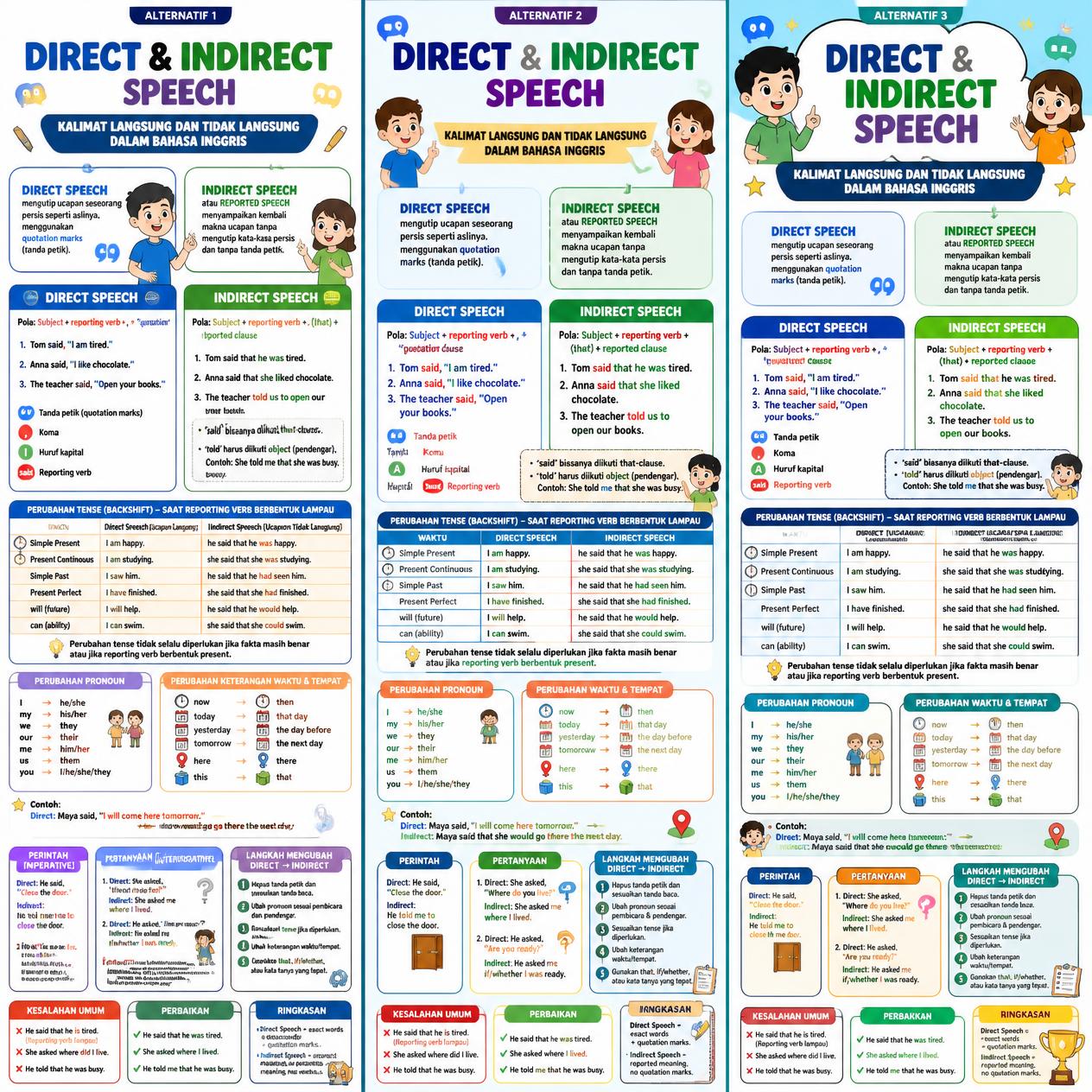
DIRECT & INDIRECT SPEECH
Materi Lengkap dan Pembahasan Lengkap
A. Pengertian Direct Speech
Direct Speech adalah kalimat yang menyampaikan perkataan seseorang secara langsung, persis seperti yang diucapkan oleh orang tersebut.
Dalam Direct Speech, ucapan asli biasanya ditulis di dalam quotation marks (“…”) atau tanda petik.
Contoh:
Rina said, “I am happy.”
Artinya:
Rina berkata, “Saya senang.”
Bagian “I am happy” merupakan perkataan asli Rina.
Ciri-ciri Direct Speech
- Menggunakan tanda petik “…”.
- Menggunakan perkataan asli pembicara.
- Biasanya terdapat reporting verb seperti:
- said = berkata
- told = memberitahu
- asked = bertanya
- answered = menjawab
- explained = menjelaskan
- Huruf pertama dalam kutipan biasanya menggunakan huruf kapital.
B. Pengertian Indirect Speech
Indirect Speech adalah kalimat yang menyampaikan kembali perkataan seseorang tanpa mengutip kata-kata persis dari pembicara.
Indirect Speech juga disebut Reported Speech.
Contoh:
Direct:
Rina said, “I am happy.”
Indirect:
Rina said that she was happy.
Artinya:
Rina berkata bahwa dia senang.
Perhatikan perubahan:
I → she
am → was
C. Perbedaan Direct dan Indirect Speech
| Direct Speech | Indirect Speech |
|---|---|
| Menggunakan tanda petik | Tidak menggunakan tanda petik |
| Menggunakan ucapan asli | Melaporkan kembali ucapan |
| Pronoun dapat tetap seperti ucapan asli | Pronoun dapat berubah |
| Tense dapat berupa bentuk asli | Tense sering mengalami perubahan |
| Keterangan waktu dapat tetap | Keterangan waktu dapat berubah |
Contoh:
Direct:
Andi said, “I study English.”
Indirect:
Andi said that he studied English.
Artinya:
Andi berkata bahwa dia belajar bahasa Inggris.
D. Bagian-Bagian Direct Speech
Perhatikan:
Budi said, “I am tired.”
Ada dua bagian:
1. Reporting Speech
Budi said
Artinya:
Budi berkata.
2. Reported Speech
“I am tired.”
Artinya:
“Saya lelah.”
E. Reporting Verb
Reporting verb adalah kata kerja yang digunakan untuk melaporkan perkataan seseorang.
Beberapa reporting verb yang umum:
| Verb | Arti |
|---|---|
| say | mengatakan |
| said | mengatakan |
| tell | memberitahu |
| told | memberitahu |
| ask | bertanya |
| asked | bertanya |
| answer | menjawab |
| answered | menjawab |
| explain | menjelaskan |
| explained | menjelaskan |
| order | memerintahkan |
| ordered | memerintahkan |
| advise | menasihati |
| advised | menasihati |
| remind | mengingatkan |
| reminded | mengingatkan |
| promise | berjanji |
| promised | berjanji |
F. Perbedaan SAY dan TELL
Ini merupakan bagian yang sangat penting.
1. SAY
Say biasanya digunakan tanpa objek orang secara langsung.
Rina said, “I am tired.”
Indirect:
Rina said that she was tired.
2. TELL
Tell biasanya diikuti objek berupa orang.
Rina told me, “I am tired.”
Indirect:
Rina told me that she was tired.
Pola:
say + that + sentence
He said that he was busy.
tell + object + that + sentence
He told me that he was busy.
G. Perubahan Pronoun
Ketika Direct Speech diubah menjadi Indirect Speech, pronoun/kata ganti dapat berubah sesuai dengan siapa yang berbicara dan kepada siapa perkataan ditujukan.
Contoh:
Rina said, “I am happy.”
I → she
Rina said that she was happy.
Karena yang berbicara adalah Rina.
Contoh lainnya:
Budi said, “I like football.”
→
Budi said that he liked football.
I → he
Tabel Perubahan Pronoun
| Direct | Kemungkinan Indirect |
|---|---|
| I | he/she |
| me | him/her |
| my | his/her |
| mine | his/hers |
| myself | himself/herself |
| we | they |
| us | them |
| our | their |
| ours | theirs |
| you | I/we/he/she/they, tergantung konteks |
| your | my/our/his/her/their |
| yours | mine/ours/his/hers/theirs |
Contoh:
Sinta said, “My book is new.”
→
Sinta said that her book was new.
my → her
H. Perubahan Tense
Jika reporting verb menggunakan past tense, misalnya:
- said
- told
- asked
maka tense dalam reported speech umumnya mundur satu tingkat (backshift).
1. Simple Present → Simple Past
Direct:
Andi said, “I play football.”
Indirect:
Andi said that he played football.
play → played
2. Present Continuous → Past Continuous
Direct:
Rina said, “I am studying.”
Indirect:
Rina said that she was studying.
am studying → was studying
3. Present Perfect → Past Perfect
Direct:
Budi said, “I have finished my homework.”
Indirect:
Budi said that he had finished his homework.
have finished → had finished
4. Present Perfect Continuous → Past Perfect Continuous
Direct:
Sinta said, “I have been studying for two hours.”
Indirect:
Sinta said that she had been studying for two hours.
5. Simple Past → Past Perfect
Direct:
Andi said, “I visited Bali.”
Indirect:
Andi said that he had visited Bali.
visited → had visited
6. Past Continuous → Past Perfect Continuous
Direct:
Rina said, “I was reading a book.”
Indirect:
Rina said that she had been reading a book.
7. Past Perfect → Past Perfect
Past Perfect biasanya tidak berubah.
Direct:
He said, “I had finished the work.”
Indirect:
He said that he had finished the work.
8. Simple Future → Would
Direct:
Budi said, “I will help you.”
Indirect:
Budi said that he would help me.
will → would
9. Future Continuous → Would Be + V-ing
Direct:
She said, “I will be studying tonight.”
Indirect:
She said that she would be studying that night.
10. Future Perfect → Would Have + V3
Direct:
He said, “I will have finished the work.”
Indirect:
He said that he would have finished the work.
I. Tabel Perubahan Tense Lengkap
| Direct Speech | Indirect Speech |
|---|---|
| Simple Present | Simple Past |
| Present Continuous | Past Continuous |
| Present Perfect | Past Perfect |
| Present Perfect Continuous | Past Perfect Continuous |
| Simple Past | Past Perfect |
| Past Continuous | Past Perfect Continuous |
| Past Perfect | Past Perfect |
| Past Perfect Continuous | Past Perfect Continuous |
| Simple Future | Future in the Past / would |
| Future Continuous | would be + V-ing |
| Future Perfect | would have + V3 |
| Future Perfect Continuous | would have been + V-ing |
J. Perubahan To Be
Present
| Direct | Indirect |
|---|---|
| am | was |
| is | was |
| are | were |
Contoh:
She said, “I am busy.”
→
She said that she was busy.
Past
| Direct | Indirect |
|---|---|
| was | had been |
| were | had been |
Contoh:
He said, “I was sick.”
→
He said that he had been sick.
K. Perubahan Modal Verb
Beberapa modal juga mengalami perubahan.
| Direct | Indirect |
|---|---|
| will | would |
| shall | should/would |
| can | could |
| may | might |
| must | had to* |
| could | could |
| would | would |
| should | should |
| might | might |
* must → had to terutama jika menunjukkan kewajiban pada masa lampau.
Contoh:
Rina said, “I can swim.”
→
Rina said that she could swim.
L. Perubahan Keterangan Waktu
Keterangan waktu sering berubah ketika Direct Speech diubah menjadi Indirect Speech.
| Direct | Indirect |
|---|---|
| now | then |
| today | that day |
| tonight | that night |
| yesterday | the day before / the previous day |
| tomorrow | the next day / the following day |
| last night | the night before |
| last week | the previous week |
| next week | the following week |
| ago | before |
| this | that |
| these | those |
Contoh:
Andi said, “I will go tomorrow.”
→
Andi said that he would go the next day.
M. Perubahan Keterangan Tempat
Beberapa keterangan tempat juga dapat berubah.
| Direct | Indirect |
|---|---|
| here | there |
| this place | that place |
| come | go* |
Contoh:
She said, “I am here.”
→
She said that she was there.
N. Direct and Indirect Speech: Statement
Statement adalah kalimat pernyataan.
Pola Direct:
Subject + said, “Statement.”
Pola Indirect:
Subject + said + that + statement.
Contoh:
Direct:
Dika said, “I am hungry.”
Indirect:
Dika said that he was hungry.
Pembahasan:
- I → he
- am → was
- tanda petik dihilangkan
- ditambahkan that
O. Indirect Speech dengan TELL
Direct:
Mother said to me, “You are lazy.”
Indirect:
Mother told me that I was lazy.
Perubahan:
said to → told
you → I
are → was
P. Direct and Indirect Speech: Yes/No Question
Pertanyaan yang jawabannya Yes/No menggunakan:
if atau whether.
Direct:
Rina asked me, “Are you tired?”
Indirect:
Rina asked me if I was tired.
Artinya:
Rina bertanya kepadaku apakah aku lelah.
Perubahan penting:
Direct:
Are you tired?
Indirect:
if I was tired.
Tidak lagi menggunakan pola pertanyaan.
❌ Rina asked me if was I tired.
✅ Rina asked me if I was tired.
Q. Contoh Yes/No Question
1.
Direct:
He asked, “Do you like English?”
Indirect:
He asked if I liked English.
Pembahasan:
do you like → I liked
2.
Direct:
She asked, “Are you a student?”
Indirect:
She asked whether I was a student.
3.
Direct:
Budi asked me, “Can you swim?”
Indirect:
Budi asked me if I could swim.
R. Direct and Indirect Speech: WH-Question
WH-question menggunakan:
- What
- Where
- When
- Why
- Who
- Which
- How
Dalam Indirect Speech, kata tanya tetap digunakan.
Pola:
Subject + asked + object + WH-word + subject + verb
Contoh:
Direct:
Rina asked me, “Where do you live?”
Indirect:
Rina asked me where I lived.
Perhatikan:
❌ Rina asked me where did I live.
✅ Rina asked me where I lived.
S. Contoh WH-Question
1. What
Direct:
He asked me, “What do you want?”
Indirect:
He asked me what I wanted.
2. Where
Direct:
She asked, “Where does Budi live?”
Indirect:
She asked where Budi lived.
3. When
Direct:
Andi asked me, “When will you come?”
Indirect:
Andi asked me when I would come.
4. Why
Direct:
Mother asked me, “Why are you crying?”
Indirect:
Mother asked me why I was crying.
5. How
Direct:
The teacher asked, “How did you do it?”
Indirect:
The teacher asked how I had done it.
T. Direct and Indirect Speech: Command
Command atau perintah biasanya menggunakan:
tell + object + to + V1
Direct:
The teacher said to me, “Open your book.”
Indirect:
The teacher told me to open my book.
Artinya:
Guru menyuruh saya membuka buku.
U. Negative Command
Untuk perintah negatif:
tell + object + not to + V1
Direct:
Mother said to me, “Don’t go outside.”
Indirect:
Mother told me not to go outside.
Pola:
Don’t + V1 → not to + V1
V. Contoh Command Lain
1.
Father said to me, “Clean your room.”
→
Father told me to clean my room.
2.
The teacher said to the students, “Sit down.”
→
The teacher told the students to sit down.
3.
Mother said to me, “Don’t be late.”
→
Mother told me not to be late.
W. Request / Permintaan
Permintaan dapat menggunakan:
- ask
- request
- beg
Pola:
asked + object + to + V1

Post Comment