Positive, Negative & Interrogative Sentences: Pengertian, Fungsi, Rumus, Contoh, dan Cara Menggunakannya
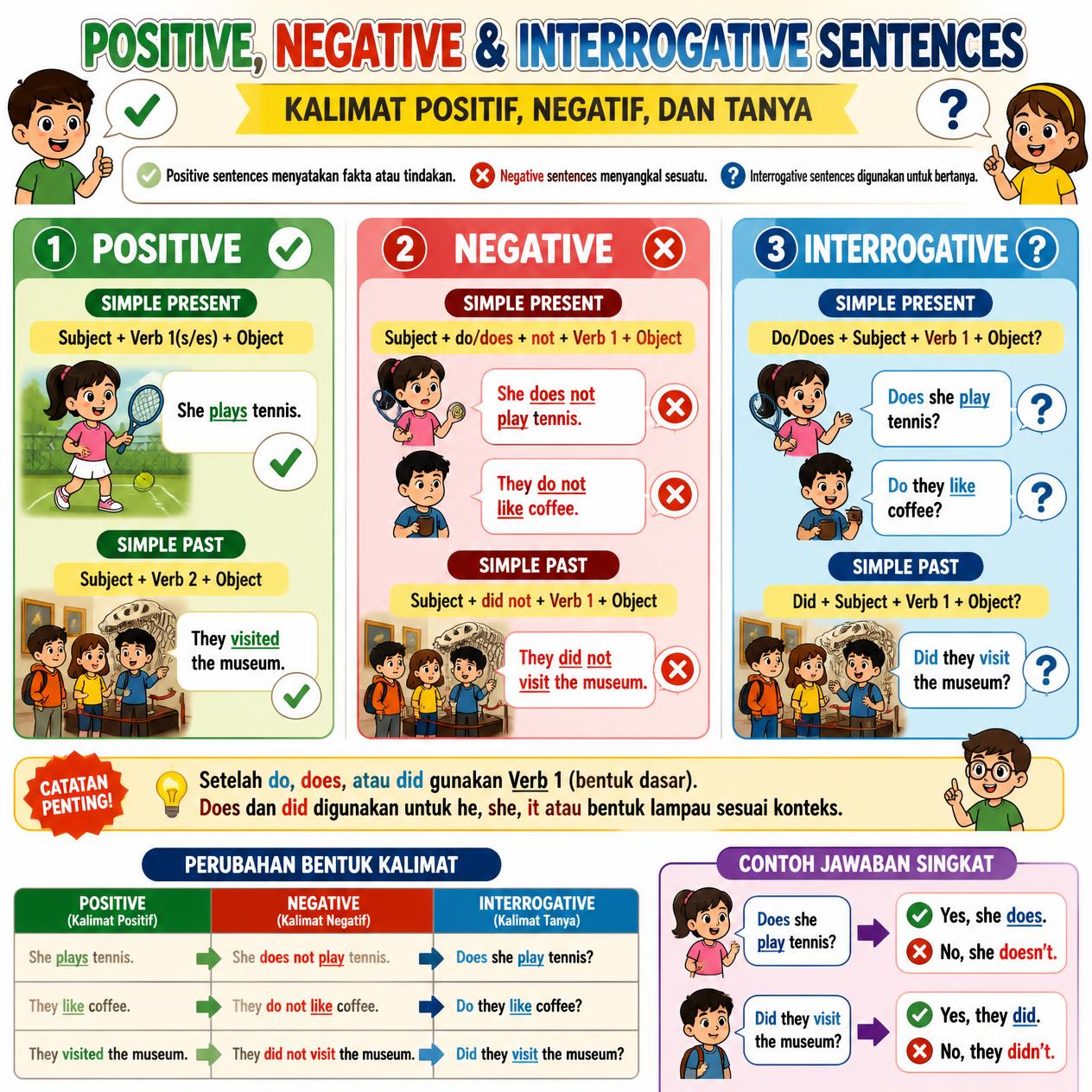
They did not visit the museum.
Interrogative:
Did they visit the museum?
Artinya:
- Mereka mengunjungi museum.
- Mereka tidak mengunjungi museum.
- Apakah mereka mengunjungi museum?
Contoh 3 — To Be
Positive:
He is tired.
Negative:
He is not tired.
Interrogative:
Is he tired?
Artinya:
- Dia lelah.
- Dia tidak lelah.
- Apakah dia lelah?
Contoh 4 — Present Continuous
Positive:
They are playing football.
Negative:
They are not playing football.
Interrogative:
Are they playing football?
Artinya:
- Mereka sedang bermain sepak bola.
- Mereka tidak sedang bermain sepak bola.
- Apakah mereka sedang bermain sepak bola?
L. PERBEDAAN DO, DOES, DAN DID
Ini sering menjadi kesalahan siswa.
DO
Digunakan dalam Simple Present untuk:
I, You, We, They
Do you like English?
They do not play football.
DOES
Digunakan dalam Simple Present untuk:
He, She, It
Does she like English?
He does not play football.
DID
Digunakan dalam Simple Past untuk semua subject.
Did you go to school?
Did she go to school?
Did they go to school?
Ingat pola penting:
DO/DOES/DID + V1
Bukan V2 atau V-ing.
❌ Does she plays football?
✅ Does she play football?
❌ Did he went home?
✅ Did he go home?
M. RINGKASAN RUMUS
| Tense | Positive | Negative | Interrogative |
|---|---|---|---|
| Simple Present | S + V1(s/es) | S + do/does + not + V1 | Do/Does + S + V1? |
| Simple Present Nominal | S + am/is/are | S + am/is/are + not | Am/Is/Are + S? |
| Simple Past | S + V2 | S + did not + V1 | Did + S + V1? |
| Simple Past Nominal | S + was/were | S + was/were + not | Was/Were + S? |
| Present Continuous | S + am/is/are + V-ing | S + am/is/are + not + V-ing | Am/Is/Are + S + V-ing? |
| Present Perfect | S + have/has + V3 | S + have/has + not + V3 | Have/Has + S + V3? |
| Simple Future | S + will + V1 | S + will not + V1 | Will + S + V1? |
N. KESALAHAN YANG SERING TERJADI
1. Menggunakan V2 setelah did
❌ Did you went to school?
✅ Did you go to school?
Pembahasan:
Karena did sudah menunjukkan bentuk lampau, verb setelahnya harus kembali ke V1.
2. Menggunakan V-s setelah does
❌ Does she likes English?
✅ Does she like English?
Pembahasan:
Ketika menggunakan does, akhiran -s/-es pada verb dihilangkan.
3. Menggunakan do untuk he/she/it
❌ She do not like coffee.
✅ She does not like coffee.
4. Menggunakan does untuk I/you/we/they
❌ They doesn’t play football.
✅ They don’t play football.
5. Salah menggunakan to be
❌ He are happy.
✅ He is happy.
❌ They is happy.
✅ They are happy.
O. LATIHAN
Ubahlah kalimat berikut menjadi negative dan interrogative.
1.
She reads a book.
2.
They play football.
3.
He goes to school.
4.
I am happy.
5.
They are students.
6.
She visited her grandmother.
7.
We watched a movie.
8.
He is tired.
9.
They are studying English.
10.
She will go to Jakarta.
P. KUNCI JAWABAN DAN PEMBAHASAN
1. She reads a book.
Negative:
She does not read a book.
Interrogative:
Does she read a book?
Pembahasan:
Subject she menggunakan does. Setelah does, reads → read.
2. They play football.
Negative:
They do not play football.
Interrogative:
Do they play football?
Pembahasan:
Subject they menggunakan do.
3. He goes to school.
Negative:
He does not go to school.
Interrogative:
Does he go to school?
Pembahasan:
Karena menggunakan does, kata kerja goes kembali menjadi go.
4. I am happy.
Negative:
I am not happy.
Interrogative:
Am I happy?
Pembahasan:
Karena kalimat menggunakan to be am, tidak perlu menggunakan do/does.
5. They are students.
Negative:
They are not students.
Interrogative:
Are they students?
Pembahasan:
Kalimat nominal menggunakan are. Untuk membuat pertanyaan, are dipindahkan ke depan.
6. She visited her grandmother.
Negative:
She did not visit her grandmother.
Interrogative:
Did she visit her grandmother?
Pembahasan:
Simple Past menggunakan did. Setelah did, visited → visit.
7. We watched a movie.
Negative:
We did not watch a movie.
Interrogative:
Did we watch a movie?
Pembahasan:
watched adalah V2. Setelah did, kembali menjadi watch (V1).
8. He is tired.
Negative:
He is not tired.
Interrogative:
Is he tired?
Pembahasan:
Karena menggunakan is, cukup tambahkan not untuk negatif dan pindahkan is ke depan untuk pertanyaan.
9. They are studying English.
Negative:
They are not studying English.
Interrogative:
Are they studying English?
Pembahasan:
Present Continuous menggunakan are + V-ing. Untuk negatif tambahkan not, sedangkan untuk pertanyaan are diletakkan di depan.
10. She will go to Jakarta.
Negative:
She will not go to Jakarta.
Interrogative:
Will she go to Jakarta?
Pembahasan:
Simple Future menggunakan will + V1. Bentuk negatif menggunakan will not, sedangkan pertanyaan menggunakan will di awal.
Q. CARA MUDAH MENGINGAT
Gunakan aturan sederhana berikut:
Jika ada DO/DOES/DID
ikuti dengan V1
Do + V1
Does + V1
Did + V1
Contoh:
Does she play?
Did she play?
Jika ada AM/IS/ARE/WAS/WERE
Tidak menggunakan do/does/did.
She is happy.
She is not happy.
Is she happy?
Jika ada WILL
Gunakan:
will + V1
Contoh:
He will go.
He will not go.
Will he go?
Rumus paling penting:
POSITIVE → NEGATIVE → INTERROGATIVE
She plays football.
She does not play football.
Does she play football?
Kuncinya: tentukan dulu tense, kemudian tentukan subject, setelah itu pilih auxiliary/to be yang tepat.

Post Comment