Conditional Sentences: Apa Itu, Jenis, Rumus, Fungsi, dan Cara Menggunakannya dalam Bahasa Inggris
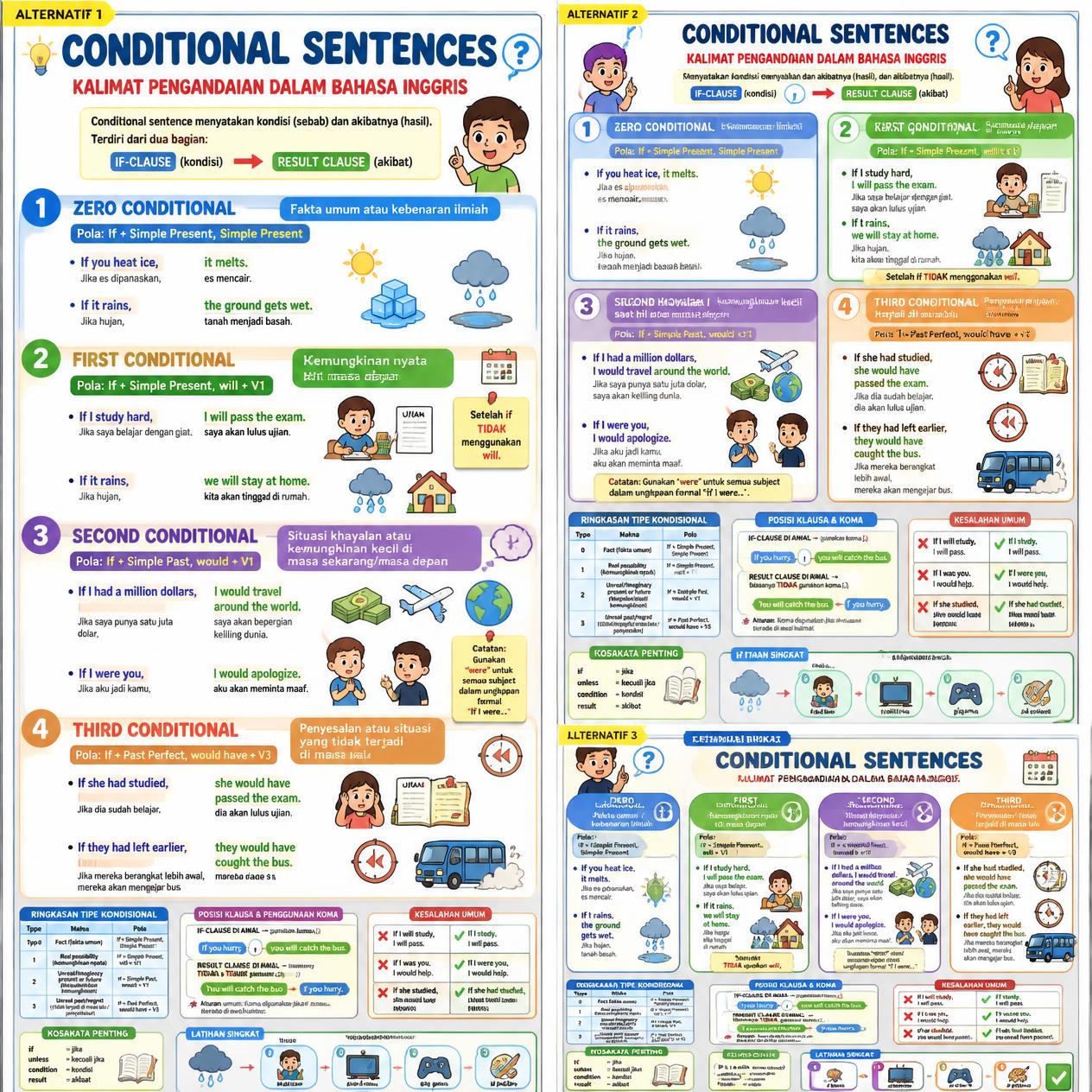
If I had bought a car, I would have driven to school.
Artinya:
Jika saya telah membeli mobil, saya pasti sudah mengendarainya ke sekolah.
Makna: saya tidak membeli mobil pada masa lalu.
F. IF CLAUSE TIDAK SELALU BERADA DI DEPAN
Kedua bentuk berikut memiliki arti yang sama:
If you study hard, you will pass the exam.
You will pass the exam if you study hard.
Jika If-clause di depan:
If you study hard, you will pass the exam.
Gunakan koma.
Jika If-clause di belakang:
You will pass the exam if you study hard.
Tidak perlu koma.
G. PENGGUNAAN UNLESS
Unless berarti:
jika tidak / kecuali jika
Secara sederhana:
unless = if … not
Contoh:
If you don’t study, you won’t pass the exam.
Dapat diubah menjadi:
Unless you study, you won’t pass the exam.
Artinya:
Jika kamu tidak belajar, kamu tidak akan lulus ujian.
Perhatikan
Jangan menggunakan not setelah unless dalam pola biasa.
Unless you study, … ✅
Unless you don’t study, … ❌
H. PENGGUNAAN AS LONG AS
As long as berarti:
selama / asalkan
Contoh:
You can use my computer as long as you are careful.
Artinya:
Kamu boleh menggunakan komputer saya selama kamu berhati-hati.
Contoh lain:
You can go outside as long as you finish your homework.
Kamu boleh pergi keluar asalkan kamu menyelesaikan pekerjaan rumahmu.
I. PENGGUNAAN PROVIDED THAT
Provided that berarti:
asalkan / dengan syarat bahwa
Contoh:
You can join the trip provided that you get permission from your parents.
Artinya:
Kamu boleh mengikuti perjalanan tersebut asalkan kamu mendapatkan izin dari orang tuamu.
J. PENGGUNAAN WHEN DAN IF
When dan if tidak selalu sama.
When
Digunakan ketika sesuatu diharapkan terjadi.
When I arrive home, I will call you.
Ketika saya sampai di rumah, saya akan meneleponmu.
If
Digunakan ketika sesuatu masih merupakan kemungkinan.
If I arrive home early, I will call you.
Jika saya sampai di rumah lebih awal, saya akan meneleponmu.
K. KESALAHAN YANG SERING TERJADI
1. Menggunakan “will” setelah if pada First Conditional
❌ If I will study, I will pass.
✅ If I study, I will pass.
Penjelasan
Setelah if, dalam First Conditional biasanya digunakan Simple Present, bukan will.
2. Salah menggunakan V2
❌ If I will have money, I would buy a car.
✅ If I had money, I would buy a car.
Karena ini Second Conditional:
If + V2 → would + V1
3. Salah menggunakan V2 setelah would
❌ I would went.
✅ I would go.
Setelah would, gunakan:
V1
Contoh:
would go
would study
would buy
would help
4. Salah menggunakan V2 setelah had
❌ If I had went…
✅ If I had gone…
Setelah had, gunakan V3.
Contoh:
| V1 | V2 | V3 |
|---|---|---|
| go | went | gone |
| eat | ate | eaten |
| see | saw | seen |
| take | took | taken |
| write | wrote | written |
| buy | bought | bought |
L. CARA MUDAH MEMBEDAKAN CONDITIONAL
Gunakan kata kunci berikut:
ZERO
Fakta / selalu benar
If + V1 → V1
FIRST
Mungkin terjadi
If + V1 → will + V1
SECOND
Khayalan / tidak nyata sekarang
If + V2 → would + V1
THIRD
Penyesalan / masa lalu
If + had + V3 → would have + V3
M. CONTOH ANALISIS LENGKAP
Contoh 1
If you heat water, it boils.
Jenis: Zero Conditional
Alasan: menyatakan fakta umum.
Rumus:
If + Simple Present, Simple Present
Contoh 2
If I study hard, I will pass the exam.
Jenis: First Conditional
Alasan: kemungkinan terjadi di masa depan.
Rumus:
If + Simple Present, will + V1
Contoh 3
If I were rich, I would buy a big house.
Jenis: Second Conditional
Alasan: situasi khayalan/tidak nyata saat ini.
Rumus:
If + Simple Past, would + V1
Contoh 4
If I had studied harder, I would have passed the exam.
Jenis: Third Conditional
Alasan: membicarakan keadaan masa lalu yang tidak terjadi.
Rumus:
If + Past Perfect, would have + V3
N. LATIHAN
A. Pilih jawaban yang tepat
1.
If you heat ice, it _____.
A. melts
B. will melt
C. would melt
D. melted
Jawaban: A. melts
Pembahasan:
Kalimat menyatakan fakta umum sehingga menggunakan Zero Conditional.
If + Simple Present → Simple Present
2.
If I study hard, I _____ the exam.
A. passed
B. would pass
C. will pass
D. had passed
Jawaban: C. will pass
Pembahasan:
Ini First Conditional karena menunjukkan kemungkinan di masa depan.
If + Simple Present → will + V1
3.
If I were rich, I _____ around the world.
A. travel
B. will travel
C. would travel
D. traveled
Jawaban: C. would travel
Pembahasan:
Ini Second Conditional.
If + Simple Past → would + V1
4.
If she had studied harder, she _____ the test.
A. passes
B. will pass
C. would pass
D. would have passed
Jawaban: D. would have passed
Pembahasan:
Ini Third Conditional.
If + had + V3 → would have + V3
5.
If I _____ you, I would apologize.
A. am
B. was
C. were
D. have been
Jawaban: C. were
Pembahasan:
Ungkapan pengandaian:
If I were you…
digunakan untuk memberikan saran.
O. LATIHAN MELENGKAPI KALIMAT
- If it rains tomorrow, we _____ at home.
(stay) - If I were rich, I _____ many countries.
(visit) - If you heat water, it _____.
(boil) - If she studies hard, she _____ the exam.
(pass) - If I had known the answer, I _____ you.
(tell)
Jawaban
- will stay
- would visit
- boils
- will pass
- would have told
P. RINGKASAN CONDITIONAL SENTENCES
| Type | Makna | Rumus | Contoh |
|---|---|---|---|
| Zero | Fakta umum | If + V1, V1 | If you heat ice, it melts. |
| First | Kemungkinan nyata | If + V1, will + V1 | If I study, I will pass. |
| Second | Khayalan/tidak nyata | If + V2, would + V1 | If I were rich, I would travel. |
| Third | Penyesalan masa lalu | If + had + V3, would have + V3 | If I had studied, I would have passed. |
| Mixed | Masa lalu → akibat sekarang | If + had + V3, would + V1 | If I had studied, I would know it now. |
Kunci paling mudah diingat
ZERO → V1 + V1
FIRST → V1 + WILL
SECOND → V2 + WOULD
THIRD → HAD + V3 + WOULD HAVE + V3
If you study this pattern carefully, you will understand Conditional Sentences more easily.
Jika kamu mempelajari pola ini dengan teliti, kamu akan lebih mudah memahami Conditional Sentences.

Post Comment