“Apa Itu Auxiliary Verbs? Pengertian, Jenis, Fungsi, Contoh, dan Cara Penggunaannya”
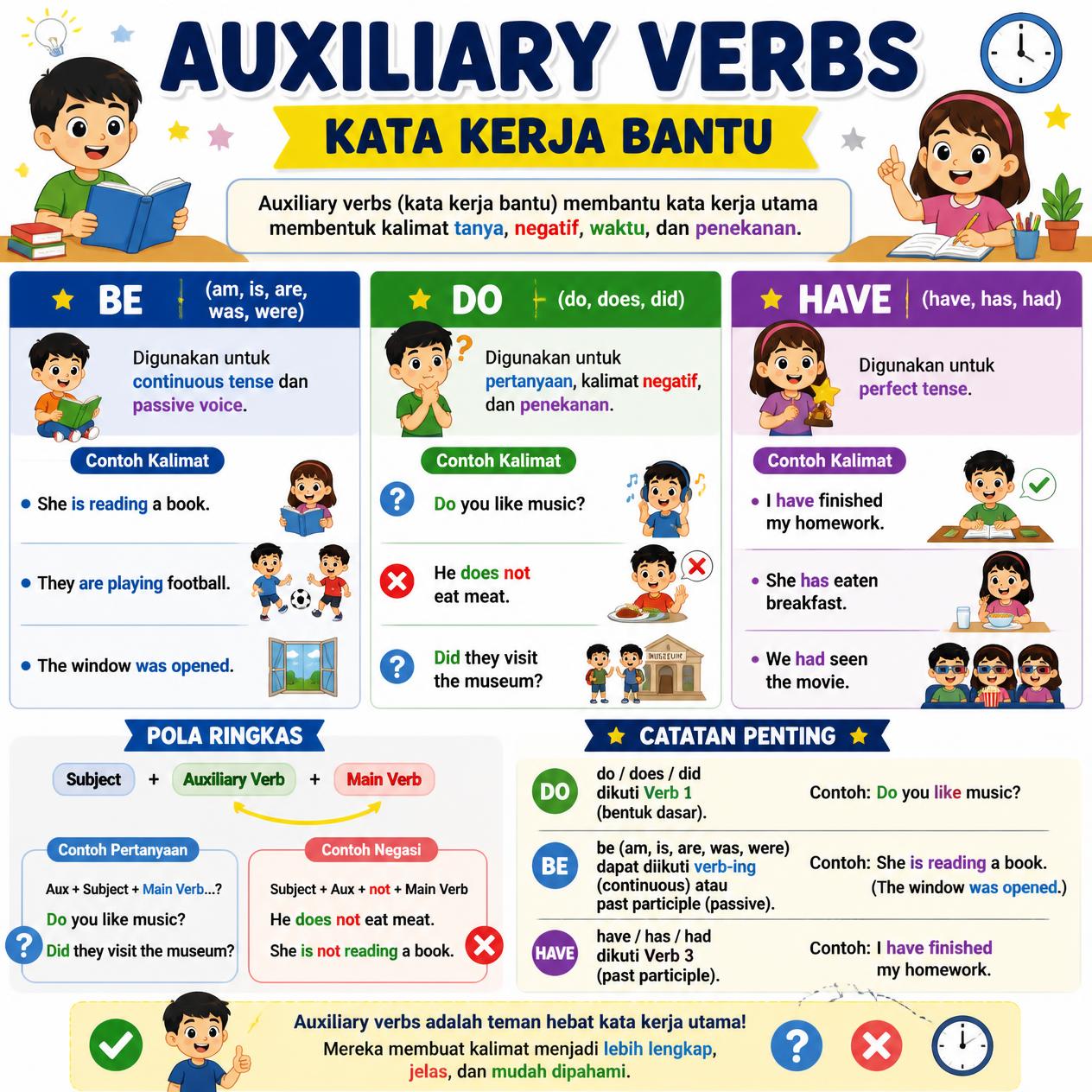
She has eaten.
Had
She had eaten.
M. HAVE/HAS/HAD SEBAGAI MAIN VERB
Ini bagian yang sangat penting.
Have, has, had tidak selalu merupakan auxiliary verb.
Kadang-kadang mereka menjadi kata kerja utama yang berarti mempunyai/memiliki.
Contoh:
I have a car.
Saya mempunyai sebuah mobil.
Di sini have = main verb.
She has a new bag.
Dia mempunyai tas baru.
Di sini has = main verb.
They had a house.
Mereka mempunyai sebuah rumah.
Di sini had = main verb.
N. HAVE/HAS/HAD DALAM KALIMAT TANYA
Ketika have/has/had berarti mempunyai, penggunaan auxiliary dapat berbeda.
Dalam pola bahasa Inggris modern yang umum:
Present:
Do you have a car?
= Apakah kamu mempunyai mobil?
Does she have a car?
= Apakah dia mempunyai mobil?
Perhatikan:
❌ Does she has a car?
✅ Does she have a car?
Karena setelah does, gunakan V1.
Past:
Did you have a car?
= Apakah kamu mempunyai mobil?
Bukan:
❌ Did you had a car?
Tetapi:
✅ Did you have a car?
O. PERBEDAAN HAVE SEBAGAI AUXILIARY DAN MAIN VERB
Bandingkan:
1. HAVE sebagai main verb
I have a book.
have = mempunyai
Pola:
S + have + noun
2. HAVE sebagai auxiliary
I have read the book.
have = kata kerja bantu
read = main verb
Pola:
S + have + V3
Artinya:
Saya telah membaca buku itu.
P. RINGKASAN BESAR
DO
I/You/We/They + do
I don’t like tea.
DOES
He/She/It + does
She doesn’t like tea.
DID
Semua subject + did
They didn’t like the food.
HAVE
I/You/We/They + have + V3
They have finished the work.
HAS
He/She/It + has + V3
She has finished the work.
HAD
Semua subject + had + V3
They had finished the work.
Q. TABEL RUMUS LENGKAP
| Auxiliary | Positif | Negatif | Interogatif |
|---|---|---|---|
| do | S + V1 | S + do not + V1 | Do + S + V1? |
| does | S + V1(s/es) | S + does not + V1 | Does + S + V1? |
| did | S + V2 | S + did not + V1 | Did + S + V1? |
| have | S + have + V3 | S + have not + V3 | Have + S + V3? |
| has | S + has + V3 | S + has not + V3 | Has + S + V3? |
| had | S + had + V3 | S + had not + V3 | Had + S + V3? |
R. CONTOH PERBANDINGAN
Simple Present
I play football.
I don’t play football.
Do you play football?
Simple Present — He
He plays football.
He doesn’t play football.
Does he play football?
Simple Past
He played football yesterday.
He didn’t play football yesterday.
Did he play football yesterday?
Present Perfect
He has played football.
He hasn’t played football.
Has he played football?
Present Perfect — They
They have played football.
They haven’t played football.
Have they played football?
Past Perfect
They had played football before it rained.
They hadn’t played football before it rained.
Had they played football before it rained?
S. KESALAHAN YANG SERING TERJADI
1. Does + V2/V-s
❌ She doesn’t likes English.
✅ She doesn’t like English.
2. Did + V2
❌ Did you went there?
✅ Did you go there?
3. Did + V3
❌ Did he eaten breakfast?
✅ Did he eat breakfast?
4. Has + V2
❌ She has went home.
✅ She has gone home.
Karena Present Perfect:
has + V3
5. Have + V2
❌ They have saw the movie.
✅ They have seen the movie.
6. Had + V2
❌ He had went home.
✅ He had gone home.
T. CARA MUDAH MENGINGAT
Gunakan pola berikut:
DO / DOES / DID → V1
do + V1
does + V1
did + V1
Contoh:
Does she play?
Did she play?
HAVE / HAS / HAD → V3
have + V3
has + V3
had + V3
Contoh:
She has played.
She had played.
Jadi:
DO → V1
DOES → V1
DID → V1
HAVE → V3
HAS → V3
HAD → V3
Ini adalah salah satu aturan terpenting untuk menghindari kesalahan.
U. LATIHAN
Pilih jawaban yang tepat.
1. ___ you like English?
A. Does
B. Do
C. Did
D. Has
2. She ___ not like coffee.
A. do
B. did
C. does
D. have
3. ___ he play football yesterday?
A. Does
B. Has
C. Did
D. Have
4. They ___ finished their homework.
A. has
B. have
C. does
D. did
5. She ___ finished her homework.
A. have
B. do
C. has
D. did
6. We ___ not seen that movie.
A. have
B. has
C. does
D. did
7. He ___ not go to school yesterday.
A. doesn’t
B. don’t
C. didn’t
D. hasn’t
8. ___ she visited Bali?
A. Has
B. Does
C. Did
D. Do
9. They ___ left before I arrived.
A. has
B. have
C. had
D. does
10. Did you ___ breakfast?
A. ate
B. eaten
C. eat
D. eats
V. KUNCI JAWABAN DAN PEMBAHASAN
1. B — Do
Do you like English?
Karena you menggunakan do dan setelah do menggunakan V1 (like).
2. C — does
She does not like coffee.
Karena she menggunakan does.
3. C — Did
Did he play football yesterday?
Karena terdapat yesterday, sehingga menggunakan Simple Past. Setelah did, gunakan V1.
4. B — have
They have finished their homework.
Karena they menggunakan have dan Present Perfect menggunakan have + V3.
5. C — has
She has finished her homework.
Karena she menggunakan has.
6. A — have
We have not seen that movie.
Karena we menggunakan have.
7. C — didn’t
He didn’t go to school yesterday.
Karena Simple Past negatif menggunakan:
S + did not + V1
8. A — Has
Has she visited Bali?
Karena she menggunakan has, dan Present Perfect menggunakan has + V3.
9. C — had
They had left before I arrived.
Kejadian had left terjadi lebih dahulu daripada I arrived, sehingga menggunakan Past Perfect.
10. C — eat
Did you eat breakfast?
Setelah did, kata kerja harus kembali ke V1.
W. KESIMPULAN
Enam auxiliary verbs ini dapat dikelompokkan menjadi dua kelompok besar:
1. DO – DOES – DID
Digunakan terutama untuk Simple Present dan Simple Past, khususnya dalam kalimat negatif dan tanya.
Do + V1
Does + V1
Did + V1
2. HAVE – HAS – HAD
Digunakan sebagai auxiliary untuk Perfect Tense.
Have + V3
Has + V3
Had + V3
Rumus paling mudah:
🟢 DO / DOES / DID → V1
🔵 HAVE / HAS / HAD → V3
Contoh paling penting:
Does she play? ✅
Did she play? ✅
Has she played? ✅
Had she played? ✅
Sedangkan:
❌ Does she plays?
❌ Did she played?
❌ Has she play?
❌ Had she played? — secara tata bahasa benar, tetapi maknanya berbeda dari bentuk simple past.
Dengan memahami pola tersebut, penggunaan do, does, did, have, has, dan had dalam kalimat tanya, negatif, dan perfect tense menjadi jauh lebih mudah.

Post Comment