Singular and Plural Nouns: What, Why, When, and How to Use Them
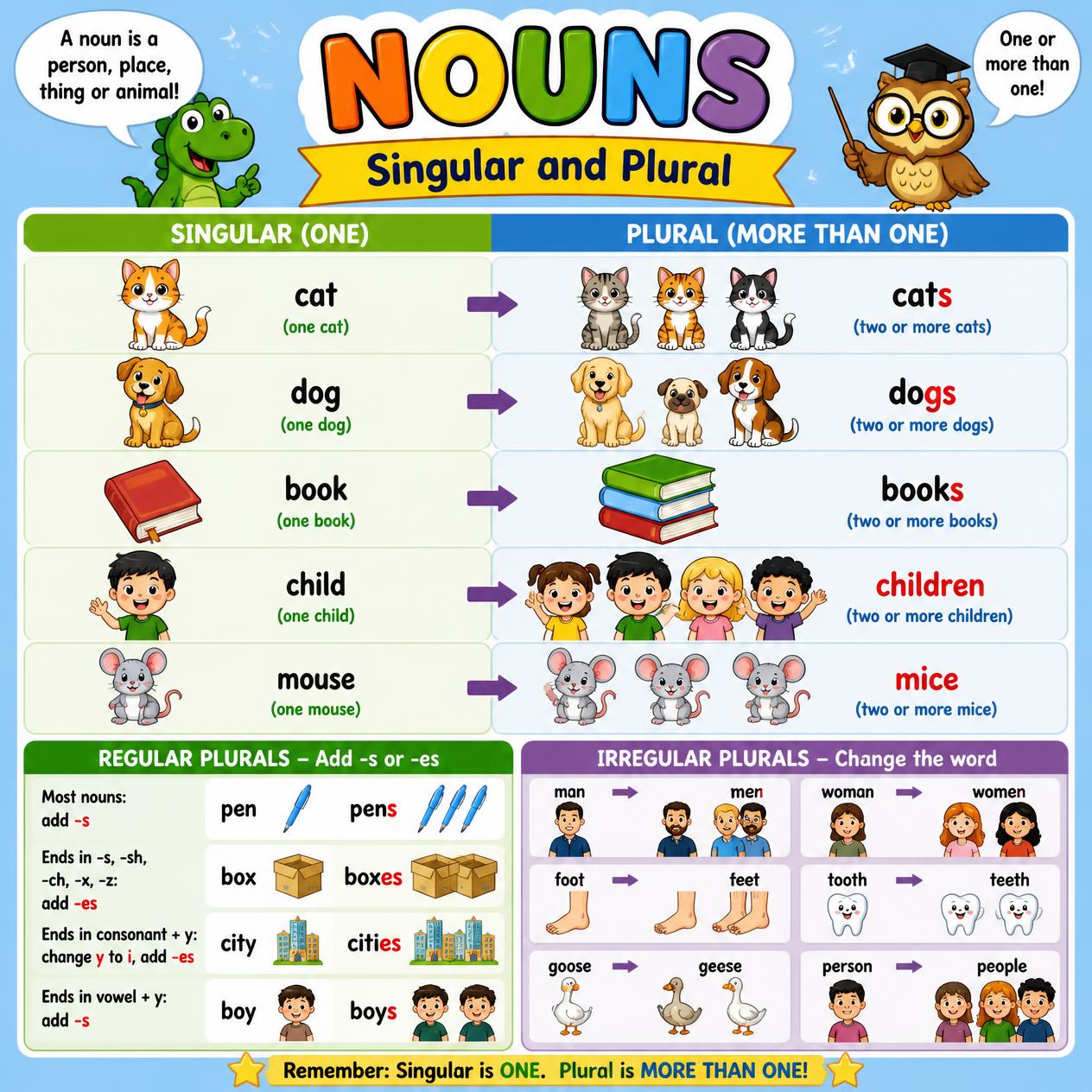
NOUNS — SINGULAR & PLURAL
Kata Benda Tunggal dan Jamak
A. Pengertian Noun
Noun adalah kata benda, yaitu kata yang digunakan untuk menyebut:
- orang (person)
- tempat (place)
- benda (thing)
- hewan (animal)
- tumbuhan (plant)
- ide atau konsep (idea/concept)
Contoh:
| English | Arti |
|---|---|
| teacher | guru |
| student | siswa |
| book | buku |
| school | sekolah |
| cat | kucing |
| tree | pohon |
| happiness | kebahagiaan |
| friendship | persahabatan |
Contoh kalimat:
This is a book.
Ini adalah sebuah buku.
The students are in the classroom.
Para siswa berada di dalam kelas.
B. Singular Noun
Singular noun adalah kata benda yang menunjukkan satu orang, satu benda, satu hewan, atau satu tempat.
Contoh:
- a book = sebuah buku
- a student = seorang siswa
- a cat = seekor kucing
- a school = sebuah sekolah
- an apple = sebuah apel
Contoh kalimat:
I have a book.
Saya mempunyai sebuah buku.
She has a cat.
Dia mempunyai seekor kucing.
There is a student in the classroom.
Ada seorang siswa di dalam kelas.
C. Plural Noun
Plural noun adalah kata benda yang menunjukkan lebih dari satu.
Contoh:
- books = buku-buku
- students = siswa-siswa
- cats = kucing-kucing
- schools = sekolah-sekolah
- apples = apel-apel
Contoh kalimat:
I have two books.
Saya mempunyai dua buku.
There are three students in the classroom.
Ada tiga siswa di dalam kelas.
D. Perbedaan Singular dan Plural
| Singular | Plural | Arti |
|---|---|---|
| book | books | buku |
| pen | pens | pena |
| student | students | siswa |
| teacher | teachers | guru |
| cat | cats | kucing |
| dog | dogs | anjing |
| apple | apples | apel |
| school | schools | sekolah |
Perhatikan:
one book → satu buku
two books → dua buku
one student → satu siswa
five students → lima siswa
E. Aturan Membentuk Plural Noun
1. Sebagian besar kata benda cukup ditambahkan -S
Rumus:
Singular + S = Plural
| Singular | Plural | Arti |
|---|---|---|
| book | books | buku |
| pen | pens | pena |
| table | tables | meja |
| chair | chairs | kursi |
| bag | bags | tas |
| car | cars | mobil |
| student | students | siswa |
| teacher | teachers | guru |
| apple | apples | apel |
| house | houses | rumah |
Contoh:
I have one book.
Saya mempunyai satu buku.
I have three books.
Saya mempunyai tiga buku.
F. Kata yang Berakhiran -s, -ss, -sh, -ch, -x, dan -o
Beberapa kata benda yang berakhiran bunyi tertentu biasanya mendapat -ES.
1. Akhiran -s
bus → buses
There is one bus.
Ada satu bus.
There are two buses.
Ada dua bus.
2. Akhiran -ss
class → classes
This is a class.
Ini adalah sebuah kelas.
There are five classes.
Ada lima kelas.
3. Akhiran -sh
dish → dishes
I have one dish.
Saya mempunyai satu piring.
I have three dishes.
Saya mempunyai tiga piring.
4. Akhiran -ch
watch → watches
He has a watch.
Dia mempunyai sebuah jam tangan.
They have two watches.
Mereka mempunyai dua jam tangan.
Contoh lain:
- church → churches
- sandwich → sandwiches
- bench → benches
5. Akhiran -x
box → boxes
There is one box.
Ada satu kotak.
There are four boxes.
Ada empat kotak.
Contoh:
- fox → foxes
- bus → buses
- tax → taxes
G. Kata yang Berakhiran -O
Beberapa kata yang berakhiran -o mendapat -es.
| Singular | Plural |
|---|---|
| tomato | tomatoes |
| potato | potatoes |
| hero | heroes |
| mango | mangoes |
Contoh:
I have one tomato.
Saya mempunyai satu tomat.
I have five tomatoes.
Saya mempunyai lima tomat.
Namun, tidak semua kata berakhiran -o menggunakan -es.
Contoh:
- photo → photos
- piano → pianos
- radio → radios
- video → videos
H. Kata yang Berakhiran Konsonan + Y
Jika kata berakhir dengan:
consonant + Y
maka:
Y → IES
Contoh:
baby → babies
| Singular | Plural | Arti |
|---|---|---|
| baby | babies | bayi |
| city | cities | kota |
| story | stories | cerita |
| country | countries | negara |
| family | families | keluarga |
| library | libraries | perpustakaan |
Contoh:
The baby is sleeping.
Bayi itu sedang tidur.
The babies are sleeping.
Bayi-bayi itu sedang tidur.
I. Vowel + Y
Jika sebelum Y terdapat huruf vokal:
a, e, i, o, u
maka cukup tambahkan -S.
Contoh:
boy → boys
toy → toys
day → days
key → keys
| Singular | Plural |
|---|---|
| boy | boys |
| toy | toys |
| key | keys |
| day | days |
| monkey | monkeys |
Bandingkan:
baby → babies ❌ baby + s
boy → boys ❌ boi + ies
Mengapa?
- baby → sebelum y adalah b → konsonan → babies
- boy → sebelum y adalah o → vokal → boys
J. Kata yang Berakhiran -F atau -FE
Beberapa kata yang berakhiran -f / -fe berubah menjadi -ves.
Contoh:
| Singular | Plural | Arti |
|---|---|---|
| leaf | leaves | daun |
| wolf | wolves | serigala |
| knife | knives | pisau |
| wife | wives | istri |
| life | lives | kehidupan |
| shelf | shelves | rak |
Contoh:
The leaf is green.
Daun itu berwarna hijau.
The leaves are green.
Daun-daun itu berwarna hijau.
Tetapi tidak semuanya berubah menjadi -ves.
Contoh:
- roof → roofs
- chef → chefs
- belief → beliefs
- chief → chiefs
Jadi, kata berakhiran -f/-fe harus dipelajari satu per satu.
K. Irregular Plural Nouns
Irregular plural nouns adalah kata benda jamak yang tidak mengikuti aturan umum.
Kita tidak cukup menambahkan -s atau -es.
Contoh penting:
| Singular | Plural | Arti |
|---|---|---|
| man | men | pria |
| woman | women | wanita |
| child | children | anak |
| person | people | orang |
| foot | feet | kaki |
| tooth | teeth | gigi |
| mouse | mice | tikus |
| goose | geese | angsa |
| ox | oxen | sapi |
| sheep | sheep | domba |
Contoh:
The man is a teacher.
Pria itu adalah seorang guru.
The men are teachers.
Para pria itu adalah guru.
L. Man → Men
man → men
One man is standing outside.
Seorang pria sedang berdiri di luar.
Three men are standing outside.
Tiga pria sedang berdiri di luar.
M. Woman → Women
woman → women
She is a woman.
Dia adalah seorang wanita.
They are women.
Mereka adalah para wanita.
Perhatikan pengucapannya:
woman → /ˈwʊmən/
women → /ˈwɪmɪn/
N. Child → Children
child → children
Bukan:
❌ childs
Yang benar:
✅ children
There is one child in the room.
Ada satu anak di dalam ruangan.
There are five children in the room.
Ada lima anak di dalam ruangan.
O. Person → People
person → people
Bukan:
❌ persons untuk penggunaan umum sehari-hari.
Contoh:
One person is waiting.
Satu orang sedang menunggu.
Five people are waiting.
Lima orang sedang menunggu.
P. Foot → Feet
foot → feet
My foot hurts.
Kaki saya sakit.
My feet are tired.
Kaki saya lelah.
Q. Tooth → Teeth
tooth → teeth
I have one broken tooth.
Saya mempunyai satu gigi yang patah.
I brush my teeth every morning.
Saya menyikat gigi setiap pagi.
R. Mouse → Mice
mouse → mice
There is a mouse under the table.
Ada seekor tikus di bawah meja.
There are two mice under the table.
Ada dua tikus di bawah meja.
S. Plural yang Bentuknya Sama
Ada beberapa kata yang bentuk singular dan pluralnya sama.
Contoh:
| Singular | Plural | Arti |
|---|---|---|
| sheep | sheep | domba |
| fish | fish | ikan |
| deer | deer | rusa |
| species | species | spesies |
| aircraft | aircraft | pesawat |
Contoh:
I see one sheep.
Saya melihat seekor domba.
I see five sheep.
Saya melihat lima ekor domba.
T. Singular dan Plural dengan A / AN
A dan AN digunakan untuk singular countable noun.

Post Comment