Subject–Verb Agreement: Apa, Mengapa, Kapan, dan Bagaimana Cara Menggunakannya?
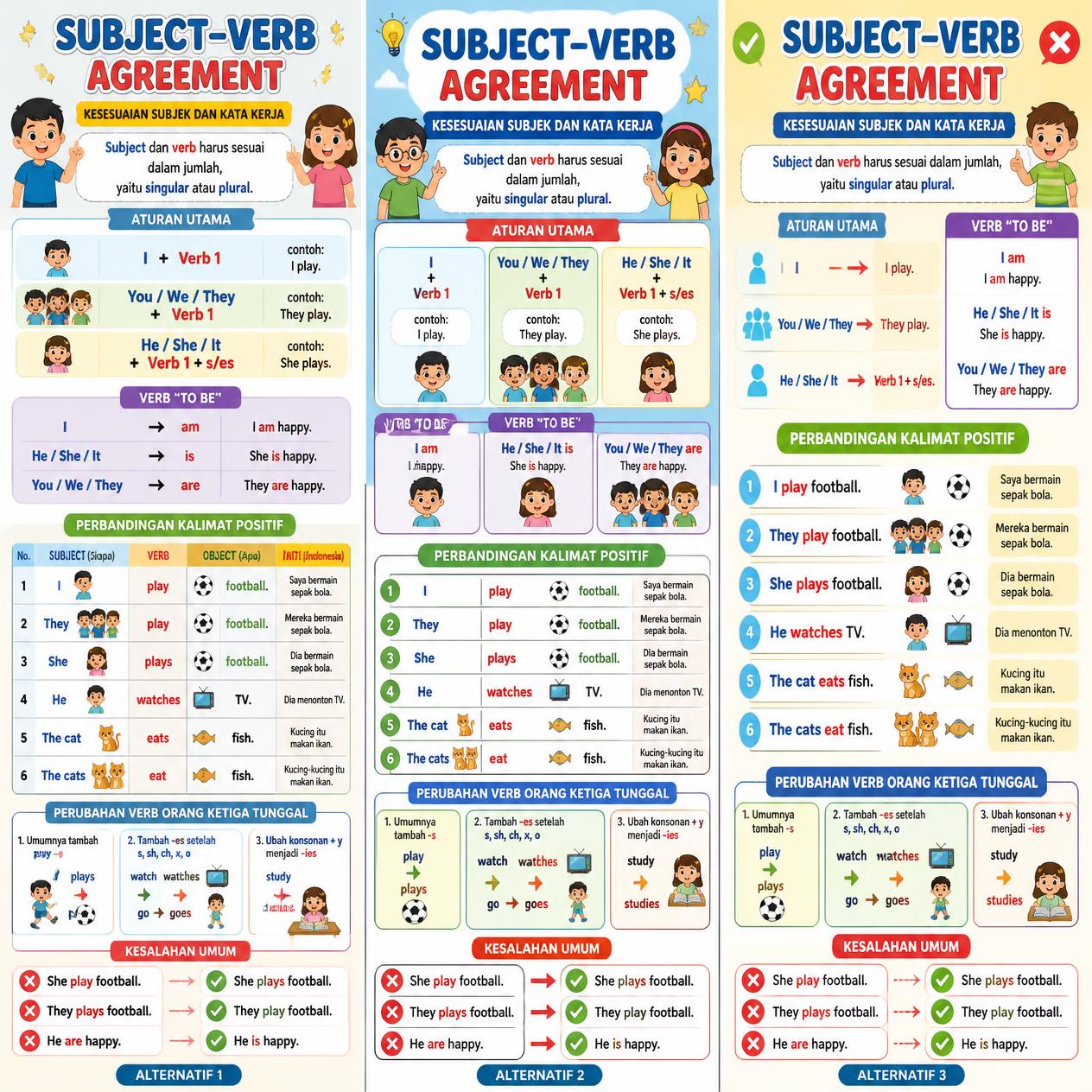
SUBJECT–VERB AGREEMENT: PENGERTIAN, ATURAN, RUMUS, DAN CONTOH
1. Pengertian Subject–Verb Agreement
Subject–Verb Agreement adalah aturan dalam bahasa Inggris yang mengharuskan subject (subjek) dan verb (kata kerja) sesuai dalam hal jumlah (number).
Artinya:
- Singular subject (subjek tunggal) → menggunakan singular verb.
- Plural subject (subjek jamak) → menggunakan plural verb.
Contoh:
She works at a school.
Dia bekerja di sebuah sekolah.
She = singular → works
They work at a school.
Mereka bekerja di sebuah sekolah.
They = plural → work
Jadi, perubahan verb sangat penting terutama dalam Simple Present Tense.
2. Apa Itu Subject?
Subject adalah orang, benda, hewan, atau sesuatu yang melakukan tindakan atau menjadi pokok pembicaraan.
Subject tunggal:
- I
- He
- She
- It
- Rina
- The teacher
- My brother
- A cat
- The book
Subject jamak:
- We
- You
- They
- Rina and Sinta
- The teachers
- My brothers
- The cats
- The books
3. Apa Itu Verb?
Verb adalah kata kerja yang menunjukkan tindakan atau keadaan.
Contoh:
| Verb | Arti |
|---|---|
| eat | makan |
| study | belajar |
| work | bekerja |
| play | bermain |
| read | membaca |
| write | menulis |
| go | pergi |
| like | menyukai |
| have | mempunyai |
| do | melakukan |
4. Aturan Dasar Subject–Verb Agreement
Aturan paling penting:
Singular Subject → Verb + s/es
Contoh:
He plays football.
Dia bermain sepak bola.
She reads a book.
Dia membaca sebuah buku.
Rina studies English.
Rina belajar bahasa Inggris.
Plural Subject → Verb dasar
Contoh:
They play football.
Mereka bermain sepak bola.
We read books.
Kami membaca buku.
Rina and Sinta study English.
Rina dan Sinta belajar bahasa Inggris.
5. Subject–Verb Agreement dalam Simple Present
Perhatikan tabel berikut:
| Subject | Verb |
|---|---|
| I | work |
| You | work |
| We | work |
| They | work |
| He | works |
| She | works |
| It | works |
Rumus
I / You / We / They + V1
They study English.
He / She / It + V1-s/es
She studies English.
6. Penggunaan -S pada Verb
Pada umumnya, tambahkan -s pada kata kerja untuk he, she, it.
| V1 | He/She/It |
|---|---|
| play | plays |
| read | reads |
| eat | eats |
| drink | drinks |
| work | works |
| sleep | sleeps |
| run | runs |
| speak | speaks |
Contoh:
He plays basketball.
Dia bermain basket.
My father works in a hospital.
Ayah saya bekerja di rumah sakit.
The cat sleeps on the chair.
Kucing itu tidur di kursi.
7. Penggunaan -ES
Beberapa kata kerja menggunakan -es, terutama kata kerja yang berakhiran:
- -s
- -ss
- -sh
- -ch
- -x
- -o
Contoh:
| V1 | He/She/It |
|---|---|
| go | goes |
| do | does |
| watch | watches |
| wash | washes |
| teach | teaches |
| pass | passes |
| fix | fixes |
| miss | misses |
Contoh kalimat:
She watches television every evening.
Dia menonton televisi setiap sore.
He goes to school every day.
Dia pergi ke sekolah setiap hari.
My mother washes the dishes.
Ibu saya mencuci piring.
8. Kata Kerja Berakhiran -Y
Ada dua aturan penting.
A. Consonant + Y
Jika sebelum y adalah huruf konsonan, maka:
y → ies
Contoh:
| V1 | He/She/It |
|---|---|
| study | studies |
| study | studies |
| try | tries |
| cry | cries |
| carry | carries |
Contoh:
She studies English every day.
Dia belajar bahasa Inggris setiap hari.
He tries to help his friend.
Dia mencoba membantu temannya.
B. Vowel + Y
Jika sebelum y adalah huruf vokal, cukup tambahkan -s.
Vokal: a, i, u, e, o
Contoh:
| V1 | He/She/It |
|---|---|
| play | plays |
| enjoy | enjoys |
| stay | stays |
| buy | buys |
Contoh:
He plays football every Sunday.
Dia bermain sepak bola setiap hari Minggu.
She enjoys the movie.
Dia menikmati film tersebut.
9. Verb “BE”
Verb be memiliki bentuk yang berbeda berdasarkan subject.
Present:
| Subject | Be |
|---|---|
| I | am |
| He | is |
| She | is |
| It | is |
| You | are |
| We | are |
| They | are |
Contoh:
I am a teacher.
Saya seorang guru.
She is happy.
Dia bahagia.
They are students.
Mereka adalah siswa.
10. Verb “HAVE”
Have juga mengikuti Subject–Verb Agreement.
| Subject | Verb |
|---|---|
| I | have |
| You | have |
| We | have |
| They | have |
| He | has |
| She | has |
| It | has |
Contoh:
I have a book.
Saya mempunyai sebuah buku.
They have two cars.
Mereka mempunyai dua mobil.
She has a new bag.
Dia mempunyai tas baru.
My brother has a bicycle.
Saudara laki-laki saya mempunyai sepeda.
11. Verb “DO”
Do juga berubah mengikuti subject.
| Subject | Verb |
|---|---|
| I | do |
| You | do |
| We | do |
| They | do |
| He | does |
| She | does |
| It | does |
Contoh:
I do my homework every day.
They do their homework.
She does her homework.
He does the work carefully.
12. Subject “I”
I adalah satu orang, tetapi dalam bahasa Inggris menggunakan bentuk verb dasar.
❌ I works every day.
✅ I work every day.
❌ I plays football.
✅ I play football.
❌ I goes to school.
✅ I go to school.
Jadi:
I + V1
13. Subject “You”
You dapat berarti satu orang atau lebih dari satu orang, tetapi verb-nya menggunakan bentuk dasar.
You work hard.
You study English.
You play football.
Bukan:
❌ You works.
❌ You studies.
❌ You plays.
14. Dua Subject yang Dihubungkan dengan “AND”
Jika dua subject dihubungkan dengan and, biasanya dianggap plural.
Rumus:
Subject + and + Subject + V1
Contoh:
Rina and Sinta study English.
Tom and Jerry play together.
My father and mother work every day.
❌ Rina and Sinta studies English.
15. Subject dengan “OR” dan “NOR”
Jika subject dihubungkan dengan:
- or
- nor
- either…or
- neither…nor
Verb biasanya mengikuti subject yang paling dekat dengan verb.
Contoh:
Either Rina or Sinta is coming.
Sinta paling dekat dengan verb → singular → is
Either the teacher or the students are in the classroom.
students paling dekat → plural → are
Contoh lain:
Neither the students nor the teacher is ready.
Neither the teacher nor the students are ready.
16. Indefinite Pronouns
Beberapa pronoun selalu dianggap singular.
Contohnya:
- everyone
- everybody
- someone
- somebody
- anyone
- anybody
- no one
- nobody
- each
- every
Meskipun beberapa kata tersebut memiliki makna banyak orang, secara grammar menggunakan singular verb.
Contoh:
Everyone likes music.
Everybody has a book.
Someone is at the door.
Nobody knows the answer.
Each student has a book.
17. Everyone dan Every
Perhatikan:
Every student has a book.
Bukan:
❌ Every student have a book.
Walaupun terdapat banyak siswa secara keseluruhan, every student dianggap singular.
Contoh:
Every student needs a pencil.
Every teacher has a desk.
Everyone is ready.
18. “Each”
Each berarti “masing-masing” dan dianggap singular.
Each student has a book.
Each teacher needs a computer.
Each of the students is ready.
Perhatikan:
Each of + plural noun + singular verb
Each of the students is present.
Bukan:
❌ Each of the students are present.
19. “There is” dan “There are”
There is → singular
There is a book on the table.
Ada sebuah buku di atas meja.
There are → plural
There are three books on the table.
Ada tiga buku di atas meja.
Perhatikan:
There is + singular noun
There are + plural noun
20. Collective Nouns
Collective noun adalah kata benda yang menunjukkan kelompok.
Contoh:
- team
- family
- class
- group
- committee
- audience
- government
Dalam penggunaan bahasa Inggris standar, collective noun sering diperlakukan sebagai singular ketika kelompok dianggap sebagai satu kesatuan.
The team is ready.
The family lives in Jakarta.
The class starts at seven.
21. Uncountable Nouns
Beberapa kata benda tidak dapat dihitung secara langsung dan biasanya menggunakan singular verb.
Contoh:
- water
- milk
- rice
- information
- advice
- money
- furniture
- knowledge
- homework
Contoh:
Water is important.
Information is useful.
Money is necessary.
The furniture is expensive.
❌ The information are useful.
22. Noun yang Berakhiran -S tetapi Singular
Beberapa kata terlihat plural karena berakhiran -s, tetapi sebenarnya singular.
Contoh:
- mathematics
- physics
- economics
- news
Contoh:
Mathematics is difficult.
Physics is an interesting subject.
The news is important.
Perhatikan:
news → singular
Bukan:
❌ The news are important.
23. Judul Buku, Film, Lagu, dan Karya
Judul sebuah karya biasanya dianggap sebagai satu kesatuan, sehingga menggunakan singular verb.
“Harry Potter” is a popular book.
“The Avengers” is a famous movie.
Walaupun judulnya mungkin memiliki bentuk jamak, yang dibicarakan adalah satu karya.
24. Waktu, Uang, Jarak, dan Ukuran sebagai Satu Kesatuan
Jumlah waktu, uang, jarak, atau ukuran dapat menggunakan singular verb jika dianggap sebagai satu kesatuan.
Contoh:
Ten dollars is enough.
Sepuluh dolar cukup.
Five kilometers is a long distance for a child.
Lima kilometer adalah jarak yang jauh bagi seorang anak.
Two hours is enough.
Dua jam sudah cukup.
25. Pecahan dan Persentase
Verb dapat mengikuti noun yang dirujuk.
Contoh:
Half of the cake is gone.
cake = singular → is
Half of the students are absent.
students = plural → are
Contoh:
Fifty percent of the water is clean.
Fifty percent of the students are present.
26. “A Number of” dan “The Number of”
Ini sangat penting.
A number of + plural noun → plural verb
Artinya sejumlah/beberapa.
A number of students are absent.
The number of + plural noun → singular verb
Artinya jumlah.
The number of students is increasing.
Perhatikan perbedaannya:
A number of students are…
The number of students is…
27. Gerund sebagai Subject
Gerund adalah verb + ing yang digunakan sebagai kata benda.
Gerund sebagai subject biasanya dianggap singular.
Swimming is good for your health.
Reading is my hobby.
Playing football is fun.
Learning English takes time.
Walaupun aktivitasnya melibatkan banyak orang, gerund tersebut dianggap sebagai satu aktivitas.
28. Infinitive sebagai Subject
Infinitive:
to + V1
Jika digunakan sebagai subject, biasanya menggunakan singular verb.
To study English is important.
To exercise every day is healthy.
To help others is a good thing.
29. Relative Pronoun “Who/Which/That”
Verb harus menyesuaikan dengan noun yang dirujuk.

Post Comment