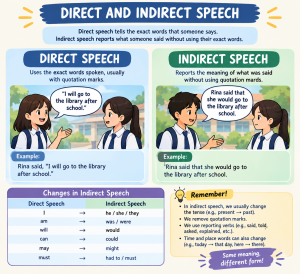
DIRECT AND INDIRECT SPEECH
Kalimat Langsung dan Kalimat Tidak Langsung
1. Pengertian Direct Speech
Direct Speech adalah kalimat yang menyampaikan ucapan seseorang persis seperti yang diucapkan. Biasanya menggunakan tanda petik (“…”).
Artinya: Kalimat langsung.
Contoh:
Rina said, “I am happy.”
Artinya: Rina berkata, “Saya senang.”
Pada kalimat tersebut, ucapan Rina ditulis sama persis seperti ucapan aslinya.
2. Pengertian Indirect Speech
Indirect Speech adalah kalimat yang menyampaikan kembali perkataan seseorang tanpa mengutip perkataan tersebut secara langsung.
Artinya: Kalimat tidak langsung.
Contoh:
Direct Speech:
Rina said, “I am happy.”
Indirect Speech:
Rina said that she was happy.
Artinya:
Rina berkata bahwa dia senang.
Perhatikan bahwa beberapa bagian berubah:
I → she
am → was
tanda petik dihilangkan
biasanya ditambahkan that
3. Perbedaan Direct dan Indirect Speech
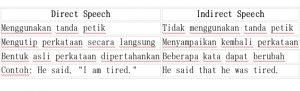
Contoh: He said, “I am tired.” He said that he was tired.
Contoh lain:
Direct:
Andi said, “I like English.”
Artinya:
Andi berkata, “Saya suka bahasa Inggris.”
Indirect:
Andi said that he liked English.
Artinya:
Andi berkata bahwa dia menyukai bahasa Inggris.
4. Struktur Direct Speech
Direct Speech biasanya mempunyai dua bagian:
A. Reporting Speech
Bagian yang menunjukkan siapa yang berbicara.
Contoh:
Sinta said,
Artinya: Sinta berkata,
B. Reported Speech
Bagian yang berisi perkataan orang tersebut.
Contoh:
“I am studying English.”
Artinya: “Saya sedang belajar bahasa Inggris.”
Gabungan:
Sinta said, “I am studying English.”
Artinya:
Sinta berkata, “Saya sedang belajar bahasa Inggris.”
5. Struktur Indirect Speech
Pola umum:
Subject + reporting verb + that + reported speech
Contoh:
Sinta said that she was studying English.
Artinya:
Sinta berkata bahwa dia sedang belajar bahasa Inggris.
Kata that berarti bahwa.
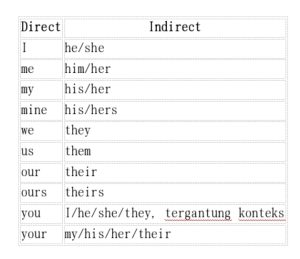
6. Perubahan Pronoun
Ketika Direct Speech diubah menjadi Indirect Speech, pronoun/kata ganti sering mengalami perubahan.
Direct Indirect
Contoh 1
Direct:
Budi said, “I am tired.”
Indirect:
Budi said that he was tired.
Artinya:
Budi berkata bahwa dia lelah.
I → he karena yang berbicara adalah Budi.
Contoh 2
Direct:
Siti said, “My mother is a teacher.”
Indirect:
Siti said that her mother was a teacher.
Artinya:
Siti berkata bahwa ibunya adalah seorang guru.
my → her
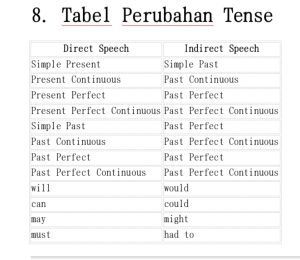
7. Perubahan Tense
Jika reporting verb menggunakan past tense, seperti:
said
told
asked
maka tense dalam reported speech biasanya mengalami backshift atau perubahan ke bentuk lampau.
A. Simple Present → Simple Past
Direct:
He said, “I play football.”
Indirect:
He said that he played football.
Artinya:
Dia berkata bahwa dia bermain sepak bola.
Rumus:
Simple Present → Simple Past
B. Present Continuous → Past Continuous
Direct:
She said, “I am reading a book.”
Indirect:
She said that she was reading a book.
Artinya:
Dia berkata bahwa dia sedang membaca buku.
Perubahan:
am/is/are + V-ing → was/were + V-ing
C. Present Perfect → Past Perfect
Direct:
Rudi said, “I have finished my homework.”
Indirect:
Rudi said that he had finished his homework.
Artinya:
Rudi berkata bahwa dia telah menyelesaikan pekerjaan rumahnya.
Perubahan:
have/has + V3 → had + V3
D. Simple Past → Past Perfect
Direct:
Ani said, “I visited Bali.”
Indirect:
Ani said that she had visited Bali.
Artinya:
Ani berkata bahwa dia telah mengunjungi Bali.
Perubahan:
V2 → had + V3
E. Past Continuous → Past Perfect Continuous
Direct:
He said, “I was studying.”
Indirect:
He said that he had been studying.
Artinya:
Dia berkata bahwa dia sedang belajar.
Perubahan:
was/were + V-ing → had been + V-ing
F. Past Perfect → Past Perfect
Past Perfect biasanya tidak berubah.
Direct:
She said, “I had eaten.”
Indirect:
She said that she had eaten.
Artinya:
Dia berkata bahwa dia sudah makan.
9. Perubahan Keterangan Waktu
Keterangan waktu juga dapat berubah.
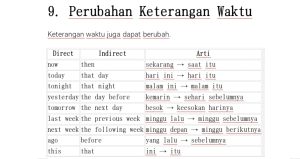
Contoh:
Direct:
He said, “I will go tomorrow.”
Indirect:
He said that he would go the next day.
Artinya:
Dia berkata bahwa dia akan pergi keesokan harinya.
10. Perubahan Keterangan Tempat
Beberapa keterangan tempat juga dapat berubah.
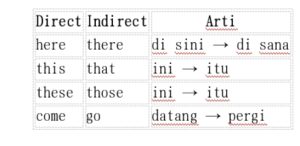
Contoh:
Direct:
She said, “I live here.”
Indirect:
She said that she lived there.
Artinya:
Dia berkata bahwa dia tinggal di sana.
11. Direct and Indirect Speech dengan “Said”
Said berarti berkata/mengatakan.
Pola:
Subject + said + that + sentence
Contoh:
Direct:
Tom said, “I am hungry.”
Indirect:
Tom said that he was hungry.
Artinya:
Tom berkata bahwa dia lapar.
12. Said dan Told
Keduanya memiliki arti yang hampir sama, tetapi penggunaannya berbeda.
Said
Biasanya:
Subject + said + that + clause
Contoh:
Rina said that she was tired.
Artinya:
Rina berkata bahwa dia lelah.
Told
Biasanya:
Subject + told + object + that + clause
Contoh:
Rina told me that she was tired.
Artinya:
Rina mengatakan kepada saya bahwa dia lelah.
❌ Salah:
Rina told that she was tired.
✅ Benar:
Rina told me that she was tired.
13. Indirect Speech untuk Kalimat Pernyataan
Kalimat pernyataan menggunakan said that atau told + object + that.
Direct:
Dika said, “I like English.”
Indirect:
Dika said that he liked English.
Artinya:
Dika berkata bahwa dia menyukai bahasa Inggris.
14. Direct and Indirect Speech untuk Yes/No Question
Untuk pertanyaan yang jawabannya Yes/No, kita dapat menggunakan:
if atau whether
Contoh:
Direct:
Budi asked, “Are you happy?”
Indirect:
Budi asked if I was happy.
Artinya:
Budi bertanya apakah saya bahagia.
Perhatikan bahwa bentuk pertanyaan berubah menjadi kalimat pernyataan.
❌ Jangan:
Budi asked if was I happy.
✅ Benar:
Budi asked if I was happy.
15. Contoh Yes/No Question
Direct:
Mother asked, “Are you hungry?”
Indirect:
Mother asked if I was hungry.
Artinya:
Ibu bertanya apakah saya lapar.
Direct:
Andi asked, “Do you like football?”
Indirect:
Andi asked if I liked football.
Artinya:
Andi bertanya apakah saya suka sepak bola.
16. Indirect Speech untuk WH-Question
WH-question menggunakan:
What = apa
Where = di mana
When = kapan
Why = mengapa
Who = siapa
How = bagaimana
Contoh:
Direct:
She asked, “Where do you live?”
Indirect:
She asked where I lived.
Artinya:
Dia bertanya di mana saya tinggal.
Perhatikan:
Where do you live?
menjadi:
where I lived
Bukan:
❌ where did I live
17. Contoh WH-Question
What
Direct:
He asked, “What are you doing?”
Indirect:
He asked what I was doing.
Artinya:
Dia bertanya apa yang sedang saya lakukan.
Where
Direct:
She asked, “Where do you study?”
Indirect:
She asked where I studied.
Artinya:
Dia bertanya di mana saya belajar.
When
Direct:
Rudi asked, “When will you come?”
Indirect:
Rudi asked when I would come.
Artinya:
Rudi bertanya kapan saya akan datang.
Why
Direct:
Mother asked, “Why are you late?”
Indirect:
Mother asked why I was late.
Artinya:
Ibu bertanya mengapa saya terlambat.
18. Indirect Speech untuk Perintah
Untuk kalimat perintah, kita dapat menggunakan:
told + object + to + V1
Direct:
Teacher said, “Open your book.”
Indirect:
The teacher told us to open our books.
Artinya:
Guru menyuruh kami membuka buku kami.
19. Perintah Negatif
Gunakan:
told + object + not to + V1
Direct:
Mother said, “Don’t play outside.”
Indirect:
Mother told me not to play outside.
Artinya:
Ibu menyuruh saya untuk tidak bermain di luar.
20. Contoh Perintah Lain
Direct:
The teacher said, “Sit down.”
Indirect:
The teacher told the students to sit down.
Artinya:
Guru menyuruh para siswa untuk duduk.
Direct:
Father said, “Don’t be late.”
Indirect:
Father told me not to be late.
Artinya:
Ayah menyuruh saya untuk tidak terlambat.
21. Indirect Speech untuk Permintaan
Kita dapat menggunakan:
asked + object + to + V1
Direct:
Rina said to me, “Please help me.”
Indirect:
Rina asked me to help her.
Artinya:
Rina meminta saya untuk membantunya.
22. Indirect Speech untuk Larangan
Gunakan:
told + object + not to + V1
Direct:
The teacher said, “Don’t make noise.”
Indirect:
The teacher told the students not to make noise.
Artinya:
Guru menyuruh para siswa untuk tidak membuat keributan.
23. Perubahan Modal Auxiliary
Beberapa modal juga berubah.
Direct Indirect
will = would
can = could
may = might
shall = should/would
must = had to
Contoh Will → Would
Direct:
He said, “I will help you.”
Indirect:
He said that he would help me.
Artinya:
Dia berkata bahwa dia akan membantu saya.
Can → Could
Direct:
She said, “I can swim.”
Indirect:
She said that she could swim.
Artinya:
Dia berkata bahwa dia bisa berenang.
24. Contoh Lengkap Perubahan
Direct Speech:
Rina said, “I am studying English now.”
Langkah perubahan:
I → she
am studying → was studying
now → then
Indirect Speech:
Rina said that she was studying English then.
Artinya:
Rina berkata bahwa dia sedang belajar bahasa Inggris saat itu.
25. Contoh Direct dan Indirect Speech
1.Direct:
John said, “I am tired.”
Indirect:
John said that he was tired.
Arti:
John berkata bahwa dia lelah.
2.Direct:
Lisa said, “I like this book.”
Indirect:
Lisa said that she liked that book.
Arti:
Lisa berkata bahwa dia menyukai buku itu.
3.Direct:
Andi said, “I went to school yesterday.”
Indirect:
Andi said that he had gone to school the day before.
Arti:
Andi berkata bahwa dia telah pergi ke sekolah sehari sebelumnya.
4.Direct:
Siti said, “I will visit my grandmother tomorrow.”
Indirect:
Siti said that she would visit her grandmother the next day.
Arti:
Siti berkata bahwa dia akan mengunjungi neneknya keesokan harinya.
5.Direct:
Budi asked, “Do you like English?”
Indirect:
Budi asked if I liked English.
Arti:
Budi bertanya apakah saya menyukai bahasa Inggris.
26. Cara Mudah Mengubah Direct ke Indirect Speech
Gunakan 5 langkah berikut:
Langkah 1 — Hilangkan tanda petik
“I am happy.”
menjadi bagian dari kalimat tidak langsung.
Langkah 2 — Periksa reporting verb
Misalnya:
said
told
asked
Langkah 3 — Ubah pronoun
Contoh:
I → he/she
Langkah 4 — Ubah tense jika diperlukan
Contoh:
am → was
play → played
will → would
Langkah 5 — Ubah keterangan waktu/tempat jika diperlukan
Contoh:
now → then
today → that day
tomorrow → the next day
here → there
27. Ringkasan Rumus
A. Statement
Direct:
S + said, “S + V…”
Indirect:
S + said that + S + V…
B. Yes/No Question
Direct:
S + asked, “Do/Is/Are…?”
Indirect:
S + asked + if/whether + S + V…
C. WH-Question
Direct:
S + asked, “WH + question…?”
Indirect:
S + asked + WH + S + V…
D. Command
Direct:
S + said, “V1…”
Indirect:
S + told + object + to + V1.
E. Negative Command
Direct:
S + said, “Don’t + V1…”
Indirect:
S + told + object + not to + V1.
F. Request
Direct:
S + said, “Please + V1…”
Indirect:
S + asked + object + to + V1.
28. Latihan Soal
Ubahlah kalimat berikut menjadi Indirect Speech.
1.Rina said, “I am happy.”
2.Budi said, “I play football.”
3.Siti said, “I am reading a book.”
4.Andi said, “I went to Bali.”
5.Dika said, “I will help you.”
6.Mother asked, “Are you hungry?”
7.Teacher asked, “Do you understand?”
8.Rina asked, “Where do you live?”
9.Father said, “Open the door.”
10.Mother said, “Don’t be late.”
Kunci Jawaban
1.Rina said that she was happy.
2.Budi said that he played football.
3.Siti said that she was reading a book.
4.Andi said that he had gone to Bali.
5.Dika said that he would help me.
6.Mother asked if I was hungry.
7.The teacher asked if I understood.
8.Rina asked where I lived.
9.Father told me to open the door.
10.Mother told me not to be late.
Kesimpulan
Direct Speech = menyampaikan perkataan seseorang secara langsung.
Indirect Speech = menyampaikan kembali perkataan seseorang secara tidak langsung.
Hal terpenting yang perlu diperhatikan ketika mengubah Direct Speech menjadi Indirect Speech adalah:
Pronoun → Tense → Time/Place → Word Order
Contoh paling sederhana:
Direct: Budi said, “I am busy now.”
Indirect: Budi said that he was busy then.
Artinya: Budi berkata bahwa dia sedang sibuk saat itu.
Leave a Reply